The 7 Biggest Mistakes New Zealanders Make With Their Wills
Seven Critical Mistakes New Zealanders Make With Their Will and Estate Administration
Key Takeaways
- Almost half of New Zealand adults currently lack a valid will, leaving their estate to be distributed by rigid government formulas rather than personal choice.
- Failing to appoint a testamentary guardian is a common oversight that leaves the care of minor children to the discretion of the Family Court.
- The Administration Act 1969 dictates asset distribution when no will exists, often resulting in a spouse receiving less than expected if there are children or parents involved.
- DIY wills frequently fail due to incorrect witnessing or ambiguous wording, leading to expensive High Court applications to validate the document.
- Digital assets and cross-border property require specific legal structuring to avoid frozen accounts and double taxation across different jurisdictions.
In our experience at PK Law, we see many families arrive at our office during the most difficult times of their lives, only to find that a simple mistake in a will has made a hard situation much worse. Most New Zealanders understand that they need a will, yet there is a significant gap between intention and action. We often hear people say they will get around to it when they are older, when they have more money, or when their family situation settles down. The reality is that life rarely waits for the perfect moment.
Recent research highlights the scale of this issue. In 2024, data cited by 1News found that almost half of New Zealand adults (47%) do not have a will. Even more concerning is that two-thirds of parents have not appointed a legal guardian for their children. This means that for nearly half of our population, the state, rather than the individual, decides how their legacy is handled. Whether you are a business owner in Auckland or a retiree in Napier, these mistakes carry heavy financial and emotional consequences.

Mistake 1: Assuming You Do Not Need a Will Yet
The most common mistake we observe is the belief that a will is only for the wealthy or the elderly. Many people assume that because they do not own a house or have a large investment portfolio, their estate is too small to worry about. However, New Zealand law has a very specific threshold. If you have more than $40,000 in any single institution, such as a bank account or a KiwiSaver fund, your family must apply for a grant of probate or letters of administration to access those funds.
Without a will, your family faces a court-driven process that is both slower and more expensive than standard probate. We recommend that anyone with more than $40,000 in savings, a life insurance policy, or a KiwiSaver account should have a professionally drafted document in place. At PK Law, we provide fixed fee Wills to ensure that getting this protection is straightforward and transparent. Waiting until you have more assets often means leaving your current assets in a state of legal limbo.
Mistake 2: Failing to Appoint Guardians for Your Children
For parents, a will is about much more than money. It is the only legal mechanism you have to nominate who should care for your children if you are no longer there. As noted in the 1News report, two-thirds of New Zealand parents have failed to appoint a testamentary guardian. A testamentary guardian is a person you choose to step into your shoes to make the big life decisions for your children, such as where they live and where they go to school.
If you die without appointing a guardian, the Family Court may have to decide who takes on that role. This can lead to conflict between well-meaning family members and causes unnecessary stress for children who are already grieving. We suggest discussing this role with your chosen person before naming them in your will to ensure they are willing and able to take on the responsibility. This simple step provides immense peace of mind for young families.
Mistake 3: Assuming Everything Automatically Goes to Your Partner
A dangerous misconception we frequently encounter is the idea that a spouse or de facto partner will automatically inherit everything. If you die without a will, you die "intestate," and your estate is distributed according to the Administration Act 1969. The Act uses a rigid formula that rarely aligns with what people actually want. For example, if you have a partner and children, your partner does not get everything. Instead, the partner receives the personal effects, the first $155,000 of the estate, and only one-third of the remainder. The other two-thirds are divided among your children.
This can create a situation where a surviving partner is forced to sell the family home to pay out the children's shares (this is particularly problematic when there are children from a previous relationship) . Understanding why it is important to have a will in New Zealand is often about protecting your partner from these unintended legal consequences.
Who is Most at Risk?
The lack of estate planning is not spread evenly across our communities. A survey by the Commission for Financial Capability of 2,000 New Zealanders found that only 47% of New Zealanders had a will. The breakdown shows that 44% of women have a will compared to 51% of men. There are also significant differences in uptake across different ethnicities. Only 53% of Europeans have a will, and that number drops to 31% for Māori, 25% for Asian, and 20% for Pasifika New Zealanders. These groups are statistically more likely to face the complexities of the intestacy regime, which can be particularly challenging for large, extended, or blended families.
Mistake 4: Failing to Update Your Will After Major Life Events
A will is not a document you write once and then forget for thirty years. We recommend that you review your will every three to five years, or whenever a major life event occurs. In New Zealand, certain life changes have an immediate legal effect on your will. For instance, getting married or entering a civil union automatically revokes any existing will unless the will specifically states it was made in contemplation of that marriage. If you forget to update your will after your wedding, you are effectively back to having no will at all.
Conversely, a divorce or the dissolution of a marriage does not automatically cancel your entire will, but it does remove your ex-spouse as an executor and cancels any gifts to them. However, a separation does not have this same effect. If you separate but have not yet legally dissolved the marriage, your ex-partner could still inherit according to a will you wrote years ago. Other triggers for an update include buying a property, starting a business, or the birth of a grandchild. Keeping your will current ensures it reflects your actual life, not a version of your life from a decade ago.
Mistake 5: Getting the Signing and Witnessing Wrong
The Wills Act 2007 sets out very strict formal requirements for a will to be valid. It must be in writing, signed by the will-maker, and witnessed by at least two people who are both present at the same time the will is signed. A common and devastating mistake is having a beneficiary (someone who is receiving a gift in the will) or their spouse act as a witness. Under New Zealand law, if a beneficiary witnesses the will, the will itself remains valid, but the gift to that witness is void. They get nothing.
We have seen cases where a friend or relative was asked to witness a document as a matter of convenience, only to find out later that they lost their entire inheritance because of it. While the High Court has the power to declare a defective will valid, this requires a specific and expensive legal application. It is much safer to ensure the formalities are handled correctly the first time. Our guide to protecting your legacy provides more detail on these formal requirements to help you avoid these technical traps.
Mistake 6: Overlooking Digital Assets and Online Accounts
In the modern era, our lives are increasingly stored online. This includes everything from social media accounts and digital photos to cryptocurrencies and online business accounts. Many traditional wills focus entirely on physical assets like jewellery and real estate, completely ignoring the digital world. This is a mistake because digital assets can have both high sentimental value and significant financial worth. If your executor does not know these assets exist or does not have the authority to access them, they may be lost forever.
We advise our clients to include specific provisions for their digital life. This involves identifying what you own and providing instructions on how you want those accounts handled. For example, do you want your Facebook page memorialised or deleted? Who should have access to your cloud-stored family photos? Dealing with these items requires a proactive approach. You can find more information on how to deal with digital assets and memories in your will through our specialised resources. Including these in your planning prevents your digital legacy from becoming a source of frustration for your family.
Mistake 7: DIY Wills and Ambiguous Wording
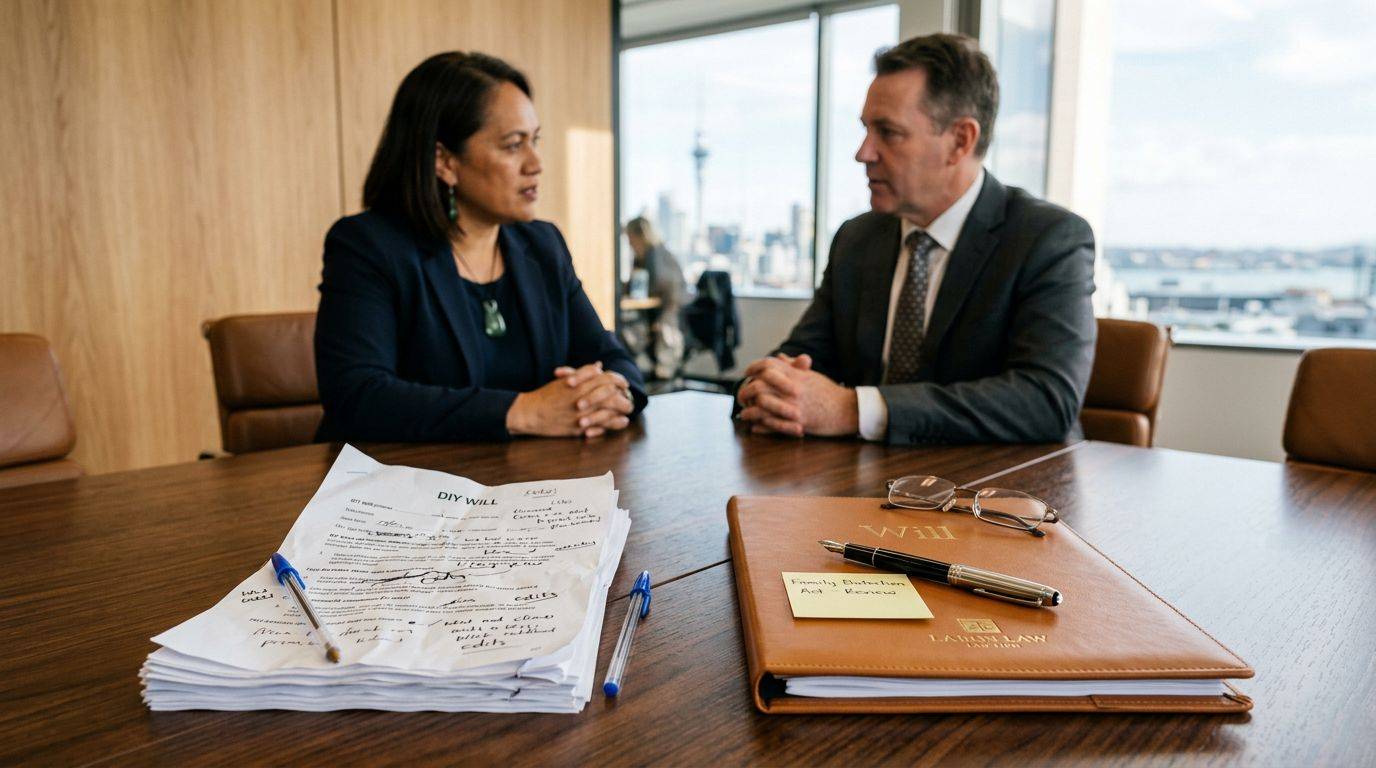
The rise of online wills and DIY kits has made it easier to create a document, but it has also increased the risk of errors. While these kits can work for very simple situations, they often fail to account for the complexities of New Zealand law, especially regarding the Family Protection Act 1955. This Act allows certain family members to claim against an estate if they feel they have not been "adequately provided for." If you want to exclude someone who would normally expect to inherit, a DIY will is rarely enough to protect your wishes.
Ambiguous language is another major pitfall. Phrases that seem clear to a layperson, such as "I leave my money to my friends," can be legally meaningless. Which friends? In what proportions? Does "money" include your shares or just your cash? These ambiguities lead directly to estate disputes. In our practice, we frequently advise on Family Protection Act and other estate claims that arise from simple will mistakes. If you find yourself in a situation where a will is being challenged,we can provide the necessary guidance. A professionally prepared will is an investment in preventing these costly legal battles.
The Real Cost of Dying Without a Will
Dying without a will is significantly more complex than the alternative. When there is no will, your family must apply for "Letters of Administration" rather than "Probate." This process requires additional searches to prove that no will exists and often requires independent legal advice for different family members to ensure the intestacy formula is applied correctly. In our experience, these applications take at least three weeks longer to be ready for the High Court than a standard probate application. During this time, your assets remain frozen. Your family cannot sell your house, access your bank accounts, or manage your investments. This delay can cause genuine financial hardship, especially if the deceased was the primary breadwinner.
Understanding the Costs of Professional Wills
We believe in transparency when it comes to legal fees. The cost of a will should reflect its complexity, ensuring you get the right level of advice for your specific situation. Our pricing structure is designed to be clear from the start.
For a Will at Complexity Level 1, which covers individuals without blended families or complex assets like trusts and businesses, the cost is $750.00 + GST. For a couple in the same situation, the fee is $1,400.00 + GST. If your situation involves a blended family, interests in a trust, or digital assets, this falls under Complexity Level 2, priced at $1,100.00 + GST for an individual or $2,000.00 + GST for a couple.
More complex cases involving donor capacity issues or a combination of many factors are Level 3, costing $2,000.00 + GST for an individual or $3,500.00 + GST for a couple. For those with international lives, our Cross-Border Assets service (Level 4) ranges from $2,000 to $3,000 + GST. This involves specialist domicile advice and liaising with overseas practitioners to ensure your assets in multiple countries are protected. We also offer an initial "Your Will, Your Way" consultation for $500.00 + GST. If you choose to proceed with a will, this cost is included in the final price. If you decide not to move forward, the fee is $500 + GST.
The Role of Enduring Power of Attorney (EPA)
While a will deals with what happens after you pass away, an Enduring Power of Attorney (EPA) is just as important for while you are alive. An EPA is a legal document that appoints someone you trust to make decisions for you if you lose the mental capacity to make them yourself. There are two types: one for Property and one for Personal Care and Welfare. Without these in place, your family may have to apply to the Family Court for the power to act on your behalf, which is a slow and invasive process. We often suggest that clients prepare their EPAs at the same time as their will to ensure full protection.
Common Questions About NZ Wills
Can you write a will without a lawyer in NZ?
You can legally write your own will in New Zealand, but it is risky. The High Court requires strict adherence to the Wills Act 2007. Any error in witnessing, signing, or wording can lead to the will being declared invalid. Given that the intergenerational wealth transfer in New Zealand is projected to reach $1.6 trillion by 2050, the risks of a DIY error are higher than ever. A lawyer ensures that your document is robust and will actually stand up in court if challenged.
What is the biggest mistake in drafting a will?
The biggest mistake is lack of clarity. Using vague terms or failing to account for what happens if a beneficiary dies before you can lead to the estate being administered in a way you never intended. Another major error is failing to consider how assets held in a family trust or joint tenancy interact with the will. Many people do not realise that jointly owned property often passes automatically to the survivor, regardless of what the will says.
Do all wills in NZ have to go through probate?
Not all wills require probate, but most do. If the deceased owned land or had more than $40,000 in any one institution, a grant of probate from the High Court is required. This grant gives the executor the legal authority to deal with the estate. If the estate is very small and does not include land, the executor may be able to administer the estate without a formal grant.
Taking the Next Step
Creating a will is one of the kindest things you can do for your family. It provides them with a clear roadmap during a time of grief and ensures that your hard-earned assets go to the people and causes you care about. Whether you need a simple document or a complex cross-border strategy, we are here to provide practical, steady advice. We pride ourselves on being straightforward and helping you achieve long-term peace of mind. If you are ready to protect your legacy, we invite you to contact us to discuss how we can help you get your affairs in order.
_Disclaimer: This article provides general information only and does not constitute legal advice. Estate law is complex and depends on individual circumstances. You should always consult with a qualified legal professional before making decisions about your will or estate planning.